Introduction
When performing emergency pipe repairs, a central question is how to accurately calculate how many rolls of STOP IT tape are required for a given pipe diameter and operating pressure. This guide provides a practical, step-by-step method together with examples, tips for underwater use, and cross-check against the manufacturer guidance distributed locally by Libratama.
Key Takeaways
Start with the manufacturer's roll-size and ply recommendations; use calculation for custom patch lengths and overlaps.
Calculation method: compute circumference, patch length, axial overlap, required plies, then derive total tape length and roll count.
50% axial overlap is a common practical assumption; increase overlap for higher safety margins.
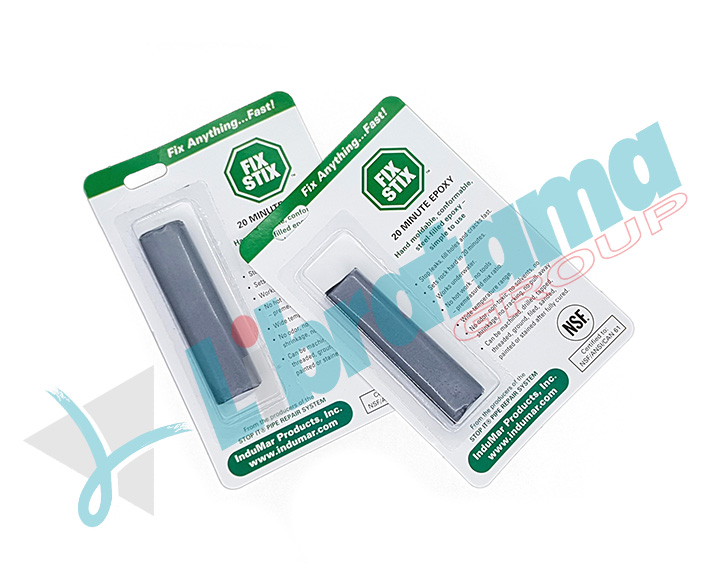
For large leaks use FIX STIX plus STOP IT for best structural repair.
1. Product data (summary)
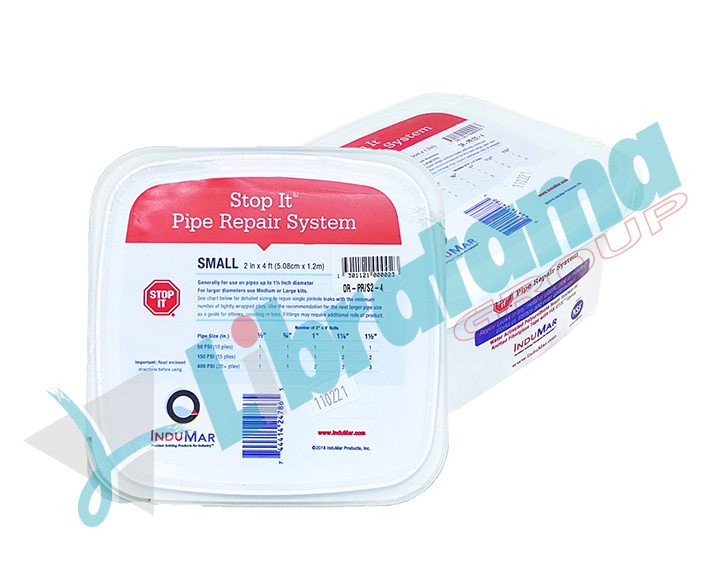
STOP IT rolls available: 2" x 4', 2" x 12', 4" x 12', and 4" x 25'.
Ply recommendations: 50 PSI ≈ 10 ply, 150 PSI ≈ 15 ply, 400 PSI ≈ 20+ ply.
Usable in wet conditions and underwater — important for emergency repairs.
2. Calculation principle
Measure pipe diameter (D) in inches.
Compute circumference C = π × D (π ≈ 3.1416).
Decide patch axial length L in inches (typical 2–6 inches).
Choose roll width W and axial overlap (e.g., 50% → advance per wrap = W × 0.5).
Select ply count P based on pressure.
Wraps per layer = ceil(L / (W × (1 - overlap))).
Total wraps = wraps per layer × P.
Total tape length required = total wraps × C.
Rolls needed = ceil(total tape length / roll length (inches)).
Practical notes
Higher overlap reduces axial advance and increases tape usage; adjust to field conditions.
Always cross-check with the STOP IT product selection table (Libratama) for minimal roll recommendations.
3. Calculation examples
Example A: 2" pipe at 150 PSI, L = 3"
D=2" → C=π×2=6.2832". Using 2"×12' roll (144" length); W=2"; overlap 50% → advance =1"; P=15. Wraps per layer = ceil(3/1)=3 → total wraps = 3×15=45 → total length ≈ 45×6.2832=282.7" → rolls = ceil(282.7/144)=2 rolls.
Example B: 4" pipe at 400 PSI, L = 4"
D=4" → C=π×4=12.5664". Using 4"×12' roll (144"); W=4"; overlap 50% → advance=2"; P=20. Wraps per layer = ceil(4/2)=2 → total wraps=2×20=40 → total length≈40×12.5664=502.66" → rolls = ceil(502.66/144)=4 rolls.
Compare with manufacturer table (which may list 3 rolls) — differences reflect chosen patch length and overlap. Use the calculation for non-standard or larger patches.
4. Practical tips & purchasing checklist
Carry 10–20% extra tape for errors and unpredictable field conditions.
Use FIX STIX for filling large holes, followed by STOP IT for reinforcement.
Account for ambient temperature — curing time changes with temperature.
For fittings and couplings, consider sizing up per manufacturer guidance.
5. Underwater application
Remove loose debris; apply quickly and ensure contact between layers.
For strong currents, use a temporary clamp or stop-gap measure to reduce flow during application.
Conclusion
Calculating STOP IT tape needs is straightforward when you combine geometric calculations with the manufacturer's ply guidance. Use the table from Libratama as a quick reference, and apply the calculation method above for custom scenarios or longer patch lengths. Always include a safety margin and consider FIX STIX + STOP IT for larger repairs.